
Deep Research and Agent Mode: A Comprehensive Guide to Features, Use Cases, and Differences
ChatGPT offers two advanced modes: **Deep Research**, which specializes in multi-step research, and **Agent Mode**, which handles everything from research to ac
3 min read
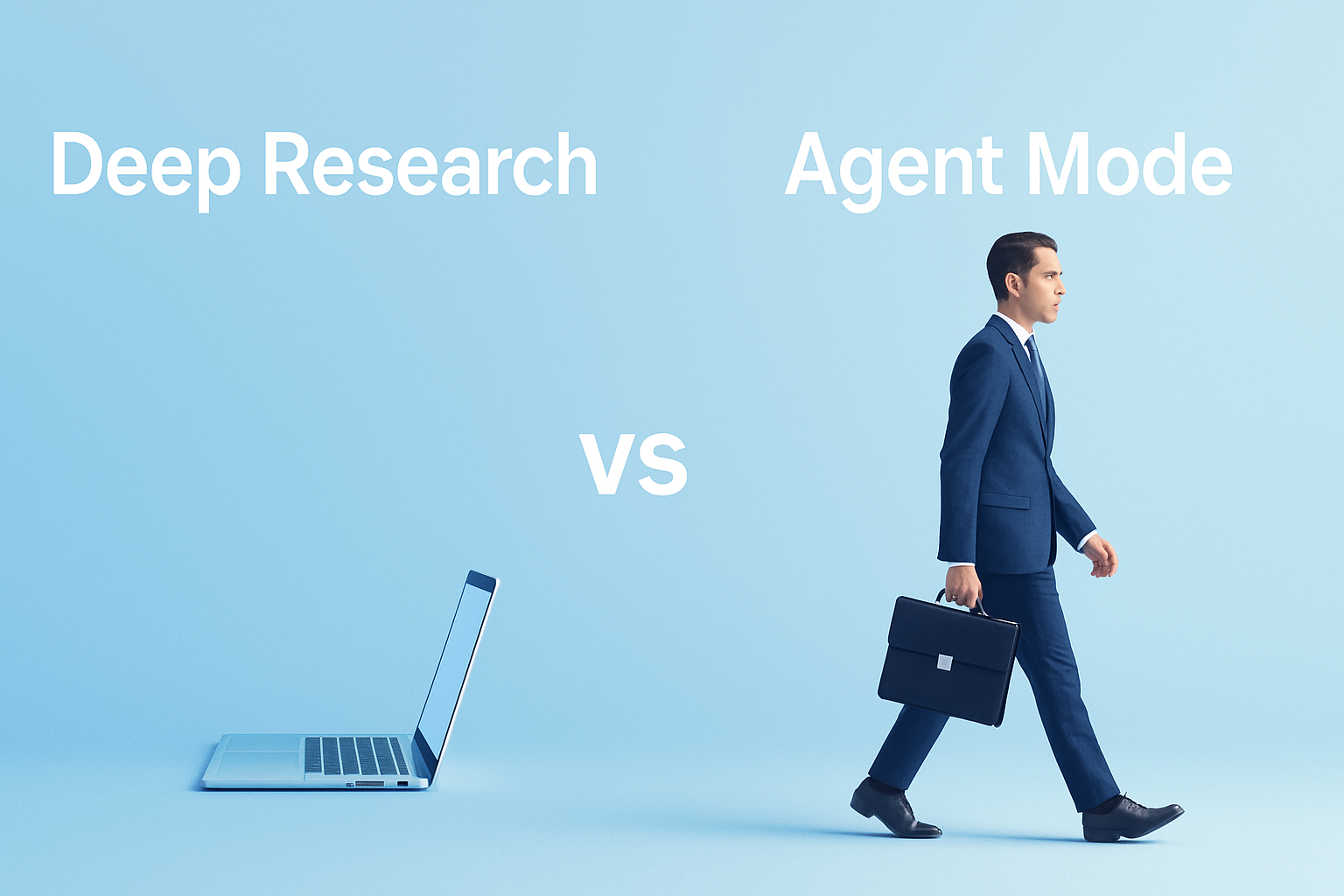
ChatGPT offers two advanced modes: Deep Research, which specializes in multi-step research, and Agent Mode, which handles everything from research to actual tasks.
We’ll clearly explain the features of each mode, how to choose between them, and their similarities and differences.
Feature and specification statements were checked on July 31, 2026 against Deep research in ChatGPT. The article distinguishes what the official source confirms from editorial organization and recommendations.
🧠 What Is Deep Research?
Deep Research is a mode that conducts research across multiple sources and generates a report that integrates and organizes the information.
The OpenAI Help Center explains it as follows:
Deep Research is a feature that “performs reasoning, research, and information synthesis to carry out complex online tasks and create documented reports.”
Features
- Automatically performs multi-step research
- Summarizes and synthesizes information from multiple sources
- Generates reports while verifying the accuracy of information
- Automatically includes citation links in results
Recommended Uses
- Academic research and report writing
- Competitor and market analysis
- Organizing trends and research developments
- Long-form output prioritizing reliability
⚙️ What is Agent Mode?
Agent Mode is a mode that allows ChatGPT to “not only think, but also act.”
It can autonomously perform tasks such as file management, scheduling, API integration, and report generation, in addition to research.
ChatGPT Agent is “an agent that understands the user’s intent and autonomously completes tasks by combining the necessary tools and services”.
Features
- Automates web searches, app operations, and integration with external tools
- Breaks down tasks, makes autonomous decisions, and executes them
- Makes corrections and retries as needed
- Can integrate with other AI systems and services depending on configuration
Ideal Use Cases
- End-to-end workflows covering research, reporting, and execution
- Automation involving schedules, files, and web operations
- Development of business assistants and agents
- “AI task delegation” combining multiple tools
🔍 Comparison: Deep Research vs. Agent Mode
Deep Research
- Purpose: To “thoroughly investigate” information
- Main Capabilities: Web search, summarization, and analysis
- Output: Report format with citations
- Interactivity: Question-driven and static (user-led)
- Suitable scenarios: Academic research, reports, market analysis, etc.
Agent Mode
- Purpose: To “research information and take action”
- Main capabilities: Search + execution (operations and automation)
- Output: Execution results + report
- Interactivity: Autonomous and dynamic (AI makes decisions and proceeds)
- Suitable scenarios: Automation, personal assistants, practical tasks, etc.
🧩 Common Features and Complementary Relationships
- Both are next-generation features that leverage GPT-5’s “reasoning capabilities”
- Deep Research excels at “delving deeper into knowledge,” while Agent Mode excels at “applying knowledge”
- It is expected that the integration of both (research + execution) will advance in the future
🧭 Summary: Which One Should You Use?
- Deep Research: When you want to thoroughly research, analyze, and organize information
- Agent Mode: When you want to complete research and execution in one go
In other words, the former is a “researcher-type AI,” while the latter is a “secretary-type AI.”
By using them appropriately for different purposes, you can maximize ChatGPT’s potential.
Related Articles
Primary sources checked
Important claims should also link to the relevant source in the article body.
- Deep research in ChatGPTOpenAI Help Center · official-help · Checked: 2026-07-31