
Will AI Change the Way Children Learn? | A Summary of Changes at Home and School Based on Official Documents
Will AI Really Change the Way Children Learn? Drawing on the Ministry of Education, Culture, Sports, Science and Technology’s Generative AI Guidelines Ver. 2.0, UNESCO’s 2024 report, and the OECD’s 2025 report, this article provides a practical overview of the changes taking place in schools and at home.
11 min read
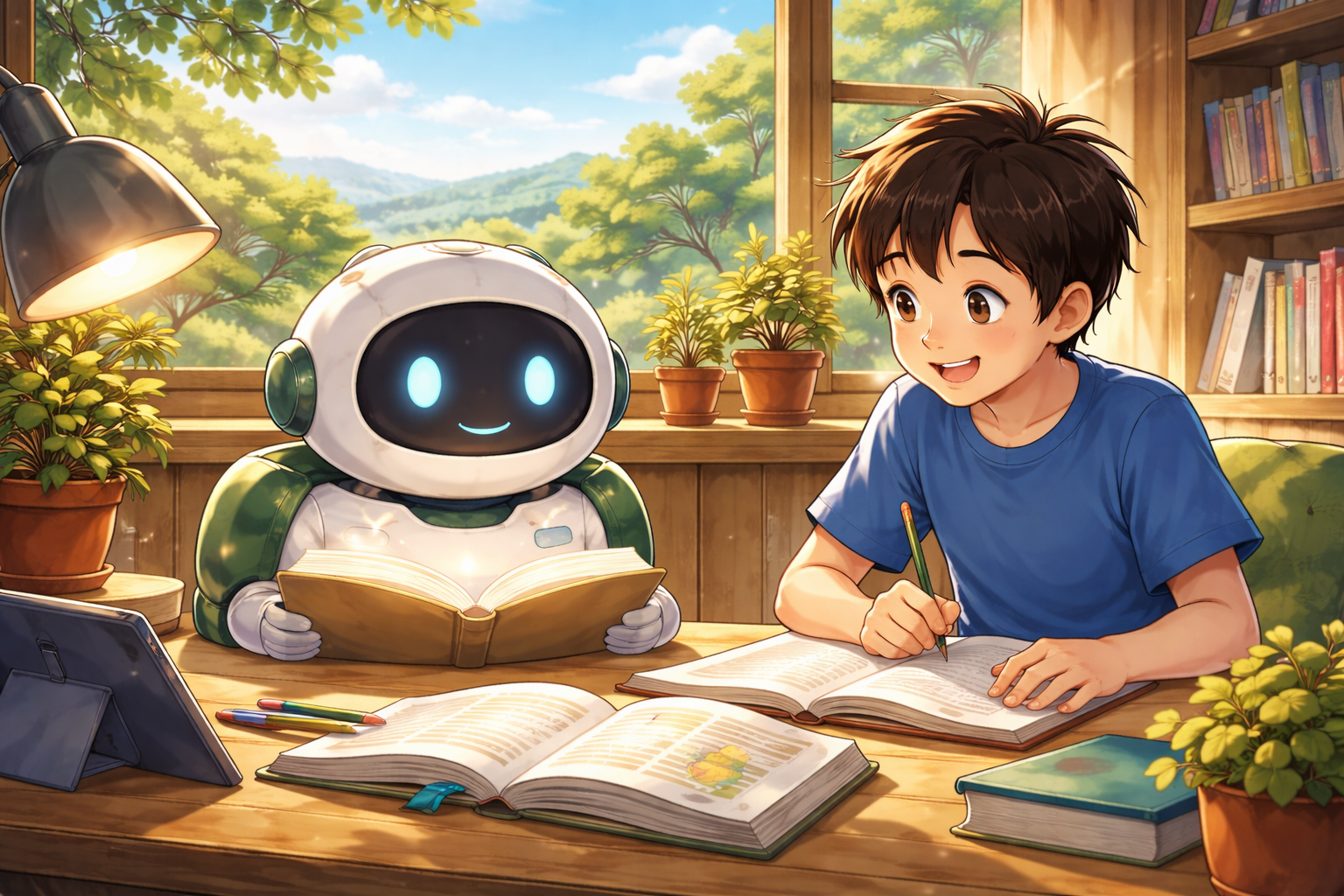
With AI becoming more widespread, many people are likely feeling anxious, wondering, “How will children’s studies change?” and “Will memorization and homework lose their significance?” While AI may seem convenient, there are also concerns that it might diminish critical thinking skills or lead to an increase in plagiarism. To put it simply, AI will change how children study. However, rather than making studying itself unnecessary, it will transform how children learn and how their learning is assessed. We’ll carefully outline what is currently happening, drawing on government documents such as the guidelines published by the Ministry of Education, Culture, Sports, Science and Technology (MEXT) on December 26, 2024, as well as materials from international organizations including UNESCO’s 2024 report and the OECD’s report published on May 23, 2025.
Will AI Change How Children Learn?
The answer is yes, it will. Moreover, the change will not be a temporary trend but a shift in the very focus of learning. The Ministry of Education, Culture, Sports, Science and Technology’s (MEXT) “Guidelines on the Use of Generative AI in Primary and Secondary Education, Ver. 2.0”—a government document—states that it neither uniformly prohibits nor mandates the use of generative AI in schools, but rather outlines principles and points to consider, based on the premise of appropriate use. A 2024 report published by UNESCO, an international organization, outlines the skills children need to use AI safely and meaningfully, while a 2025 report by the OECD asks what teachers should teach and what children should learn in the AI era.
What emerges from this is a shift in which the value of “formulating questions,” “verifying information,” and “explaining concepts” increases, rather than simply “finding answers quickly” through AI. In other words, AI does not put an end to learning; rather, it transforms the quality of learning.
The benefits include the ability to have unclear points rephrased on the spot, easier learning support at home, and access to explanations tailored to individual needs. The drawbacks include a tendency to believe plausible but incorrect answers, a tendency to look up answers before thinking them through, and potential discrepancies in rules between schools and homes. Points to keep in mind include not judging AI solely based on convenience, adjusting its use according to age, and ensuring that the final judgment rests with the child and the adults involved.
Based on my own observations of everyday AI use, the difference lies not in whether AI was used, but in whether the user thought things through again on their own after using it. This seems likely to be the turning point for learning in the future.
Specific Steps You Can Take Right Now
- Before asking AI, write down your own answer or prediction in a single sentence
- Don’t use AI’s answer as-is; compare it with textbooks and other materials
- Decide as a family to use AI not “to get the answer,” but “to deepen understanding”
How Will Schoolwork Change?
The first changes in schools will be in the design of homework, essays, and research projects. The Ministry of Education, Culture, Sports, Science and Technology’s Guidelines Ver. 2.0—a government document—were published on December 26, 2024. They outline key points for schools to follow, including considerations based on the context of use and the users involved. These guidelines clearly outline key considerations—such as the handling of personal information, respect for copyright, caution regarding bias and misinformation, and the importance of final judgment by teaching staff.
Given this trend, assignments that simply require students to “research and summarize” as they have in the past will become increasingly difficult to justify as they are. This is because AI can generate plausible-sounding text in a short amount of time. Instead, greater emphasis will be placed on comparison, verification, confirming evidence, and explaining concepts in one’s own words. Teachers, too, will increasingly need to assess not only the quality of the final answer but also the thought process and how evidence is presented.
The benefits include easier support for lesson preparation and the creation of teaching materials, the ability to better supplement explanations for students who are struggling to keep up, and the potential to broaden access to inquiry-based learning. The drawbacks include the need for policies to prevent verbatim copying and overreliance on AI, the likelihood of varying approaches across schools, and the increased difficulty of assessment. Key points to note include not judging academic ability based solely on the quality of submitted work, clearly defining whether and to what extent AI may be used, and ensuring that the value of primary sources and textbooks is not diminished.
Even in observation-based assessments, the introduction of AI shifts the focus from “the ability to write from scratch” to “the ability to revise generated text.” While this is a significant change, it also means that students who think critically will be better positioned to thrive.
Points for Schools and Families to Keep in Mind
- Have children explain whether they used AI
- Check not only the quality of writing but also the evidence and understanding behind it
- Structure assignments so that children can explain “why they thought that”
What Skills Do Children Need?
As part of its international initiatives, UNESCO published an AI Competency Framework for Students in 2024. This framework outlines the skills children need, including a human-centered mindset, AI ethics, AI technology and applications, and AI system design. In other words, the emphasis is not merely on being able to use AI, but on understanding it, engaging with it appropriately, and using it responsibly.
This goes beyond just school grades. In home learning as well, the skills that will become increasingly valuable are the ability to formulate questions, compare multiple sources of information, explain concepts clearly to others, and recognize the limitations of AI. Conversely, if children develop the habit of relying on instant answers without thinking for themselves, their understanding tends to remain superficial—even if it appears efficient on the surface.
The benefits include making it easier to identify foundational skills that will remain relevant even in the AI era, facilitating a focus on learning that goes beyond mere digital manipulation, and helping students recognize skills that will serve them well in the future. The drawbacks, from a parent’s perspective, are that results may be difficult to see, there is often no direct correlation with test scores, and the concepts can feel abstract and hard to grasp. Points to keep in mind include the fact that younger children require more adult guidance, the importance of never neglecting discussions about ethics and safety, and the need to avoid confusing convenience with correctness.
In fact, children tend to perceive AI’s definitive writing style as “sounding correct.” That is precisely why it is so important to cultivate the habit of asking, “Is that really true?” and “Are there other ways to say this?”
Skills to Cultivate at Home
- The ability to express one’s own thoughts first
- The ability not to take AI’s answers at face value
- The ability to compare and make judgments
- The ability to explain what one has learned in one’s own words
Will AI Make Memorization Unnecessary?
This is an area where misunderstandings are common. As far as officially verifiable sources are concerned, government documents and reports from international organizations do not suggest that “basic knowledge will become unnecessary because of AI.” On the contrary, a report published by the OECD on May 23, 2025, states that even in light of AI’s progress, we need to rethink what we should continue to learn. In other words, it’s not that memorization will become entirely meaningless; rather, the question is what foundation we should maintain.
If you use AI without a foundation of basic knowledge, you won’t be able to judge whether the answers it provides are correct. For example, in subjects like history, science, English, and math, it is precisely because you have a minimum level of understanding that you can recognize whether an explanation is good or bad—or if it contains errors. The more convenient AI becomes, the more the gap between those with a foundation and those without may actually widen.
The benefit is that we can move away from a focus solely on rote memorization and reevaluate the value of understanding and application. The downside is that it’s easy to jump to the conclusion that “I don’t need to memorize anything anymore.” Key points to keep in mind are: don’t underestimate the importance of foundational knowledge; don’t limit or expand the scope of what you entrust to AI too much; and keep the foundation and application separate in your thinking.
In my experience, AI is most helpful as a “gateway to learning something from scratch,” but ultimately, it’s the individual’s own understanding that matters most. Even if AI helps you get started, it won’t acquire the actual knowledge for you.
How to Approach Memorization and AI
- Master basic terminology and fundamental calculations on your own
- Use AI to aid understanding or rephrase concepts
- Don’t treat memorization and critical thinking as opposites
How to Best Use AI for Home Study
At home, AI is extremely helpful. It is particularly well-suited to helping students get started with their learning—such as rephrasing difficult topics, organizing essay structures, reviewing English compositions, and finding angles for independent research projects. On the other hand, government guidelines from the Ministry of Education, Culture, Sports, Science and Technology (MEXT) emphasize the importance of considering personal information, copyright, and information security. At home, too, it is essential to follow the basic rule of not having children enter their names, school names, photos, grades, or family circumstances.
An approach that tends to work well at home is to “use AI for review after thinking for yourself,” rather than “having it generate the answer from the start.” For example, for a book report, first write down your own thoughts and feelings. Afterward, ask the AI for suggestions on how to improve the structure or wording. For math problems, explain where you got stuck before asking for the answer, and then ask for hints on how to approach the problem. Following this sequence makes it easier to deepen understanding while reducing dependence on the AI.
The benefits include having more people to ask for help, making it easier to progress with learning without parents having to teach everything, and creating an accessible entry point for children who feel particularly insecure about a subject. The drawbacks are that it’s easy to use it in a aimless way, the temptation to copy and paste is strong, and it can be difficult for parents to grasp how it’s used. Key points to keep in mind are setting usage limits, using it with a specific purpose in mind, and always ensuring the child rephrases the answer in their own words after using it.
From a parent’s perspective, it works better to think of AI not as a “tool to make studying easier,” but as a “tool to minimize stumbling blocks in learning.” Adopting this perspective makes it easier to use the tool consistently.
Tips for Using It at Home
- Try it on your own first
- Then use AI to expand your understanding
- Finally, rephrase it in your own words
- Do not enter personal information
- Avoid using it for long periods of time without focus
Does Usage Vary by Age?
The answer is: it varies significantly. It’s a bit simplistic to blanket-state that “it’s too early for children” or to insist that “it’s better to get used to it early.” Based on the Ministry of Education, Culture, Sports, Science and Technology’s guidelines and the UNESCO framework, it’s important to adapt usage to each developmental stage.
For lower elementary school students, it’s safer to use AI together with an adult rather than on their own. The focus should be on expanding their vocabulary and fostering curiosity, rather than simply finding the “correct” answer. From upper elementary school through middle school, AI becomes practical for research projects, revising writing, and making comparisons. In high school, the range of applications expands to include inquiry-based learning, essay writing, career exploration, and foreign language learning.
The benefits include the ability to tailor usage to the child’s needs, the ease of avoiding forced adoption, and the ability to prevent dependency. The disadvantages include the tendency for household rules to become complicated, an increased burden on parents to supervise, and the difficulty of making judgments based solely on age. Key considerations include taking into account the child’s personality, academic ability, and level of self-management; recognizing that the same rules do not need to apply to all siblings; and being particularly mindful of shared use among younger children.
While there are currently no officially confirmed guidelines, there are no uniform, detailed absolute standards based on age. For this reason, it is most practical to determine a reasonable usage policy by considering both the school’s policies and the family’s specific circumstances.
Age-Based Guidelines
- Elementary school students in the lower grades: Use devices only with a parent or guardian presentFor short-term use
- Upper elementary and middle school students focus on verification and comparison
- High school students are also mindful of verifying sources and organizing key points
Summary
AI will transform how children study. However, this does not mean that studying will become unnecessary. According to government documents—specifically the Ministry of Education, Culture, Sports, Science and Technology’s Guidelines Ver. 2.0 published on December 26, 2024, as well as documents published by international organizations—UNESCO in 2024 and the OECD on May 23, 2025—it becomes clear that what will become increasingly important is not the speed at which answers are received, but the ability to formulate questions, verify them, and explain them.
The practical conclusion for families is very simple: It’s okay to use AI. However, don’t just hand everything over to it. First, think for yourself. Next, use AI to expand on your ideas. Finally, verify your own conclusions. Simply by following this order, AI becomes a tool that deepens learning rather than one that stifles critical thinking. It seems like a good idea to start today by telling your children, “Before asking AI, write down your own answer in one sentence.”
Precisely because we live in an era of great uncertainty, AI is not something that takes away children’s learning; rather, depending on how it’s used, it’s a surprisingly practical tool that clearly reflects differences in critical thinking skills—and one that is well worth engaging with right now.