
Why Did GPT-4o Disappear? An Explanation of the Reasons Behind Its Discontinuation and the Background of ChatGPT’s Evolution
Here’s a summary of why GPT-4o disappeared from ChatGPT, based on official announcements. We’ll provide a clear explanation of when the service ended, the background behind it, and its relationship to the successor model.
5 min read
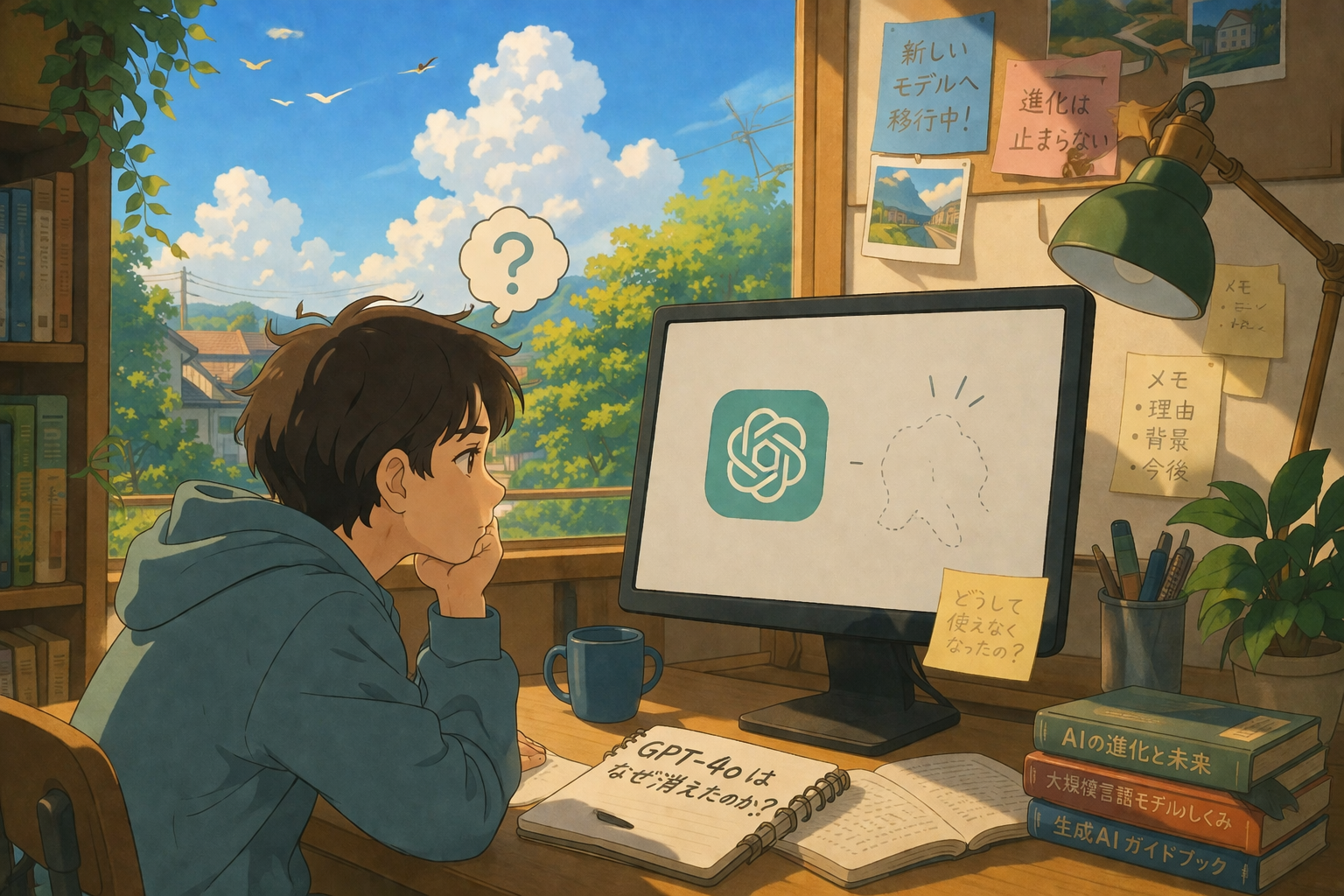
Many users may have felt that “GPT-4o suddenly stopped working.” However, in reality, its service was discontinued as part of an officially planned model update.
This guide summarizes the reasons behind GPT-4o’s discontinuation based on official documents and carefully explain its relationship with the successor model, as well as the future direction of ChatGPT.
GPT-4o Was Officially Discontinued from ChatGPT in February 2026
GPT-4o was discontinued not due to a technical failure, but as part of a planned model update.
According to the official OpenAI Help Center, GPT-4o was retired from ChatGPT on February 13, 2026 (Source: Official OpenAI Help Center, Updated: 2026).
Furthermore, it was completely phased out in Business, Enterprise, and Edu environments by April 3, 2026 (Source: OpenAI Official Help Center).
This was due to an internal model generation update within ChatGPT, and it remains available via the API (Source: OpenAI Official Announcement).
Summary of Service Discontinuation
- Discontinuation via ChatGPT: February 13, 2026
- End of transition grace period for Enterprise and other plans: April 3, 2026
- Available via the API for the time being
- Automatic migration to successor models
Benefits
- Consolidation into a higher-performance model
- Enhanced integration with search functionality
- Improved reasoning capabilities
- Improved customization options
Disadvantages
- Familiar response styles will disappear
- The conversational feel unique to GPT-4o will be lost
- Existing workflows will need to be adjusted
Points to Note
- This is not a complete removal; only the ChatGPT UI is being discontinued
- Continued use via the API is possible
- Image generation and voice-related features use separate model lines
Personal Experience or Observations
- Many users appreciated the “warmth of the conversation”
- Immediately after the transition, some users were confused by the differences in responses
- However, features such as search integration have clearly improved
Specific Actions
- Get accustomed to the GPT-5.3 series models
- Re-tune prompts
- Review Custom GPT settings
The primary reason for GPT-4o’s discontinuation is OpenAI’s model consolidation strategy
OpenAI has adopted a policy of phasing out older models and integrating them into newer ones.
According to the official announcement, the discontinuation of GPT-4o was explained as a measure to facilitate the transition to the next-generation model (Source: OpenAI Official Blog, Published: January 29, 2026).
Another reason cited is that many users had already migrated to the new model (Source: Technology news article, February 2026).
Background of the Consolidation Strategy
- Streamlining the number of models
- Concentrating development resources
- Accelerating the integration of new features
- Unifying the UI experience
Benefits
- Faster update cycles
- Ability to focus on bug fixes
- Enhanced integration with search functionality
- Improved inference performance
Drawbacks
- Reduced flexibility in selecting older models
- Need to redesign pre-trained prompts
- Differences from familiar behavior
Points to Note
- Model retirements occur periodically
- Similar transitions may occur in the future
- Long-term use requires the latest model
Real-World Experience or Observations
- Similar changes occurred during the transition from GPT-4 to GPT-4o
- ChatGPT continues to evolve through successive generational updates
- It tends to be difficult to maintain older models in a completely static state
Specific Actions
- Reduce the use of model-dependent prompts
- Create prompts with a generic design
- Utilize search integration
GPT-4o’s Features Have Been Carried Over to Successor Models
Interestingly, GPT-4o’s features have not completely disappeared.
In an official announcement, OpenAI explained that feedback from GPT-4o users was incorporated into improvements for GPT-5.1 and GPT-5.2 (Source: OpenAI Official Blog, Published: January 29, 2026).
In other words, the discontinuation is not so much a “removal” as it is an “integration.”
Inherited Features
- Natural conversation
- Creative idea generation
- Polite response style
- Personalized support
Benefits
- Ease of use is maintained in the new model
- Improved response quality
- Expanded customization options
- Individual settings are possible
Disadvantages
- Not an exact match
- Response tendencies may change
- Requires a learning curve
Points to Note
- Results may vary even with the same prompt
- Output stability depends on the model
- Requires an adaptation period
Real-World Experience or Observations
- The new model has high accuracy in integrating search results
- Long-form text structure is stable
- Information is updated quickly
Specific Actions
- Retest using the new model
- Update output templates
- Utilize GPTs
Why GPT-4o Hasn’t Completely Disappeared
Importantly, GPT-4o technically still exists.
Official documentation explicitly states that it continues to be available via the API (Source: OpenAI Help Center, Updated: 2026).
In other words, it has simply “disappeared from ChatGPT.”
Current Status
- Discontinued in ChatGPT
- Available via the API
- Underlying technology is retained
- Remains in derivative features
Advantages
- Available for development purposes
- A transition period is guaranteed
- Existing systems can be maintained
Disadvantages
- Not available to general users
- UI cannot be selected
- Possibility of future API discontinuation
Points to Note
- No official documentation confirming the API end date is currently available
- Long-term reliance is not recommended
Real-World Experience or Observations
- Previous models have also been phased out in a similar manner
- ChatGPT is designed to always transition to the latest generation
Specific Actions
- Design with the latest model in mind
- Assess API dependency
- Develop a future migration plan
Summary
GPT-4o did not disappear suddenly; its availability on ChatGPT was systematically discontinued on February 13, 2026.
This was a strategic transition aimed at integrating the model into the next generation and improving performance; its core features have been carried over to the successor model.
For now, try adjusting your prompts to work with the current standard model.
It’s strangely reassuring to know why your favorite model disappeared, but it is precisely this change that represents the cutting edge of generative AI evolution today.
Primary source checked
Primary sources checked
Important claims should also link to the relevant source in the article body.