
Why GPT Codex Max Speeds Up Stock Trading Software Development and How to Use It
This article explains why GPT Codex Max dramatically accelerates stock trading software development and provides real-world examples of chart generation, the integration of trading rules, and score-based design.
3 min read
Feature and specification statements were checked on July 31, 2026 against Codex overview. The article distinguishes what the official source confirms from editorial organization and recommendations.
Introduction
Many people want to create stock trading software but struggle with challenges such as “chart rendering and data processing logic are too difficult” or “I don’t know how to code my own rules.” However, with GPT Codex Max, complex structures are automatically organized, and development proceeds as if a skilled engineer were right by your side.
Why GPT Codex Max Speeds Up Stock Trading Software Development
Codex Understands the “Intent Behind the Specifications” and Translates Them into Code
It Does More Than Just Assist Your Thinking—It “Structures” Your Code
- Stock trading software involves many steps: data acquisition → analysis → visualization → trade decision.
- Codex automatically builds the code structure by working backward from “what you want to achieve.”
Automatically Detects Logic Conflicts
- If there are errors in the calculation formulas for moving averages or scores, it suggests corrections.
- Since it even optimizes execution speed, you can expand your code with confidence.
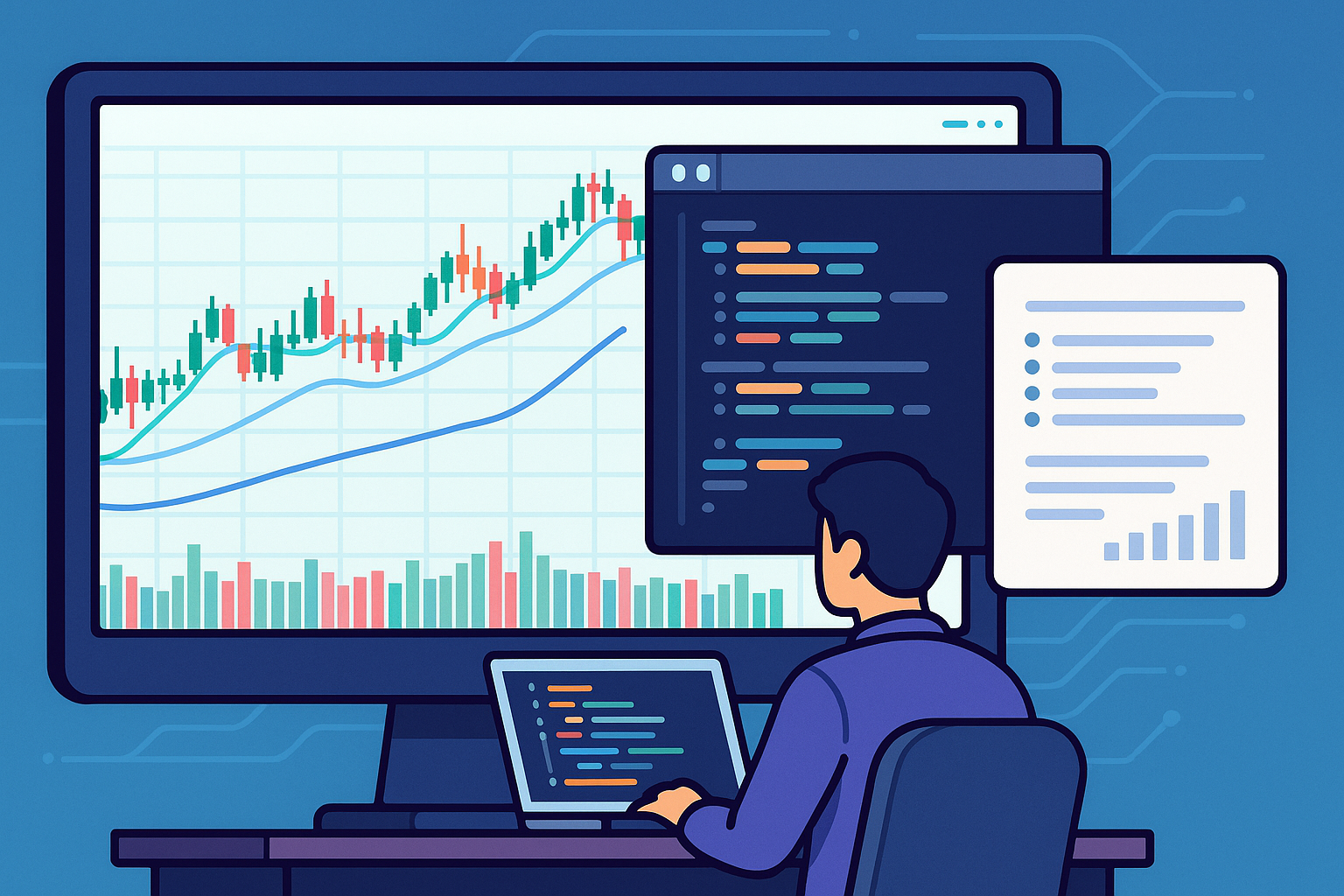
Making Chart Rendering This Easy
Automatically Generates Lightweight Charts, D3.js, and More
Build Candlesticks, Volume, and Trend Lines All at Once
- Automatically generates everything from chart initialization and rendering settings to zoom and other interactive features.
- Moving averages (5-, 20-, 60-, and 200-day) can be added instantly.
Adding 20-day and 60-day moving averages is simple
- Generates everything in one go: moving average calculations → array formatting → chart overlay.
Convert Your Rules to “Machine Code”
Turn Swing × Momentum × Score-Based Strategies into Trading Logic
Example of Score Structure Design
- Trend Score
- Momentum Score
- Volume Score
- Moving Average Deviation Score
- Volatility Score
- RSI/MACD Score
Total Score → Decision Logic
- 80 or higher: Strong Buy
- 60–79: Buy Candidate
- 40–59: Neutral
- 39 or lower: Sell
Actual Workflow: How It Accelerates the Process
“Automation Flow” Powered by Codex
1. Generating Data Retrieval Logic
- Specify sources such as Stooq or Yahoo Finance to automatically generate the necessary fetch functions.
2. Optimizing Calculation Logic
- Speeds up moving averages, returns, drawdowns, and score calculations (WASM implementation is also possible).
3. Building the Front-End UI
- Automatically generates input fields, buttons, chart rendering, and score display blocks.
4. Bug Detection and Suggested Fixes
- Proactively identifies and corrects specification inconsistencies to ensure a smooth implementation process.
Summary
The “Support Engineer” That Accelerates Stock Trading Software Development
GPT Codex Max provides end-to-end support, from organizing specifications to chart rendering, implementing trading logic, and optimization.
You’ll be able to build the ultimate “Swing × Momentum × Score” strategy—which MyRoad strives to achieve—with high reproducibility.
Text for Discover
Stock trading software development may seem complex, but with GPT Codex Max, you can implement everything from charting to trading rules with surprising ease. With AI utilization making headlines, its appeal lies in being a reliable, practical tool. It’s a development experience that lets you take the first step today.
Primary sources checked
Important claims should also link to the relevant source in the article body.
- Codex overviewOpenAI Developers · official-documentation · Checked: 2026-07-31