
The Era of AI Controlling PCs Has Begun | Understanding the Shift from “Thinking AI” to “Working AI”
The era of AI controlling PCs is beginning to become a reality. Based on official materials from OpenAI, Microsoft, and others, we’ll outline what has changed, what’s possible, and how you should use it now.
5 min read
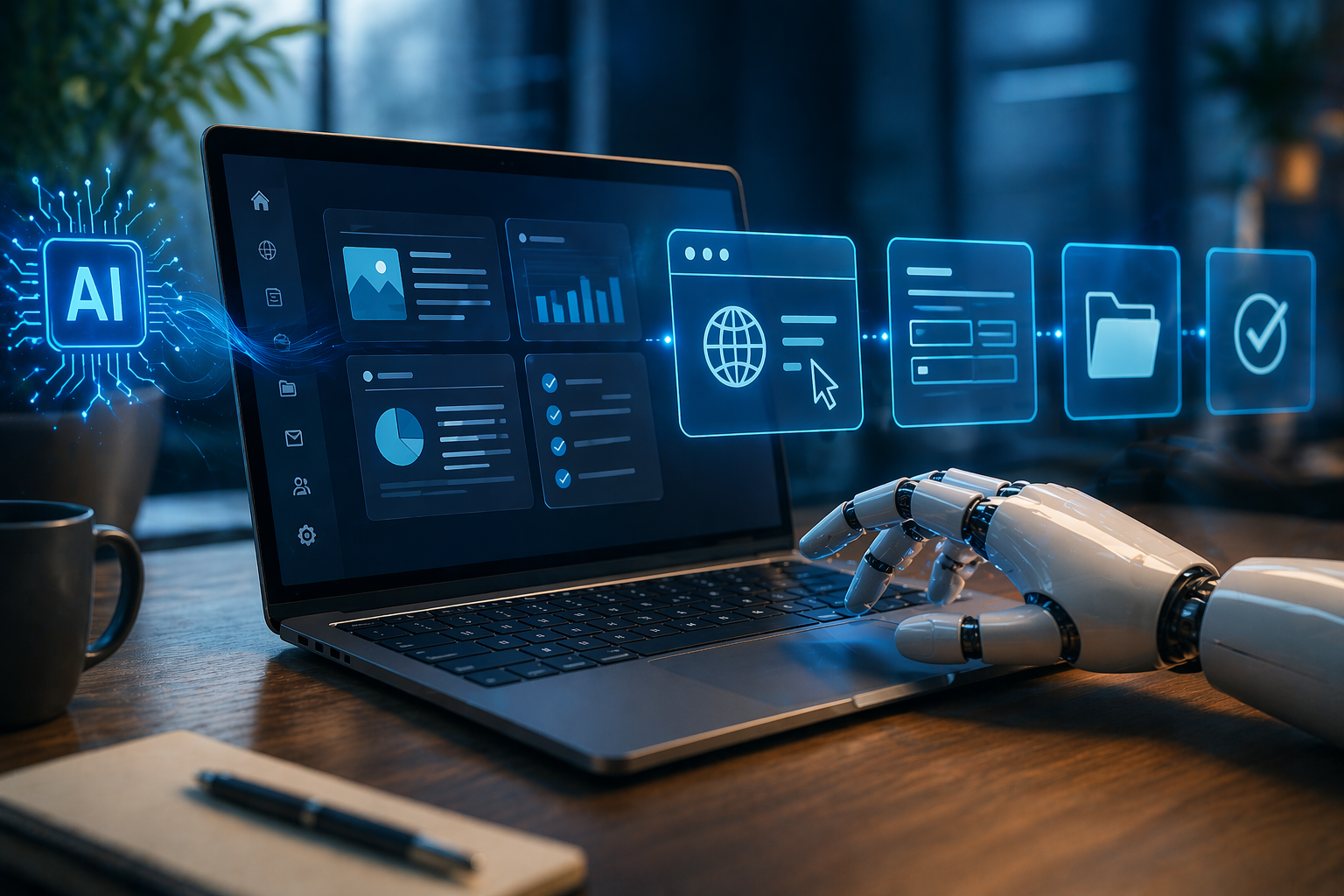
Many of you may have thought that AI was just for writing text or answering questions. However, its role is now quietly beginning to change. An era in which AI looks at the screen, clicks, types, and actually carries out tasks is truly upon us.
That said, it’s only natural to wonder, “Is this really practical?” “Isn’t it dangerous?” and “How will it change our work?” based on primary sources such as OpenAI’s official announcements (the January 2025 release of the Computer-Using Agent and the July 2025 integration of the ChatGPT agent), we’ll explore the implications of an era where AI operates PCs and outline practical ways to use this technology.
Has the Era of AI Operating PCs Truly Begun?
In short, it has already begun.
On January 23, 2025, OpenAI released the Computer-Using Agent (CUA). This is a model trained to interact with graphical user interfaces (GUIs)—such as on-screen buttons, menus, and input fields—just like a human would (OpenAI official website, published January 23, 2025).
Furthermore, on July 17 of the same year, “Operator” was integrated as a ChatGPT agent, and the feature allowing AI to click, type, and scroll using a browser was officially announced (OpenAI official website, updated July 17, 2025).
The benefit is that it reduces the two-step process of “looking something up and then performing the action yourself.” The downside is an increased risk of errors. In particular, actions such as sending messages, deleting content, and making payments require human verification.
It is evident that the value of AI is shifting from the “ability to provide answers” to the “ability to carry out tasks.”
Changes Taking Place
- AI can now perform clicks and input actions
- Browser operations have been released as an official feature
- Multi-step tasks can now be processed in a single operation
- The design is collaborative, with human verification as a prerequisite
What Exactly Is Now Possible?
Today’s AI is more than just a search assistant.
OpenAI’s Computer-Using Agent is described as being able to directly manipulate GUIs and perform tasks such as form entry and reservation processing (OpenAI official website, published January 23, 2025).
In other words, this applies to tasks such as the following.
The benefit is a reduction in repetitive work. The drawback is that effectiveness depends on the accuracy of the AI’s judgments. Critical decisions must still be made by humans.
Based on actual observations, AI tends to show results more quickly in administrative tasks than in creative work.
Tasks It Can Perform
- Gathering and organizing information
- Filling out forms
- Updating spreadsheets
- Generating draft documents
- Comparing and organizing multiple pages
Operations Requiring Caution
- Confirming payments
- Confirming email sends
- Deleting files
- Contract decisions
- Final decisions in healthcare or finance
Why Is This Trend Accelerating Now?
The reason isn’t just AI performance.
It’s because companies are shifting their focus from “AI that answers” to “AI that executes.”
Microsoft has also announced enhancements to agent-based AI in Copilot Studio and is working to improve its ability to handle multi-step tasks (Microsoft Official Blog, published November 24, 2025).
The benefit is that the time-saving effects become clear. The drawback is that the importance of permission management and security design increases.
One observation is that AI is beginning to be used not as a substitute for search, but as part of business processes.
Reasons for This Acceleration
- Chat-based AI could not complete tasks on its own
- Companies have begun prioritizing the automation of practical business processes
- GUI operation models have reached the practical application stage
- Agent-based AI has begun to be integrated into products
How Will Work and Life Change?
Creative work will not be the first thing to change.
What will change are repetitive tasks.
For example, in the following areas:
The benefit is that the psychological burden of starting a task is reduced. The drawback is the possibility of incorrect judgments due to insufficient verification.
As an observation, AI is spreading not so much to “take away jobs” but rather to reduce the “tedious parts” of work.
Jobs Likely to Change
- Routine data entry
- Organizing information
- Summarizing meeting minutes
- Preliminary research
- Preparing internal documents
Situations in Daily Life Where It Will Be Convenient
- Sorting through reservation options
- Managing household finances
- Travel preparations
- Comparing products
- Preparing documents
What New Users Should Decide First
The important question isn’t “What should I delegate?”
It’s “What shouldn’t I delegate?”
It has been officially stated that Operator is designed so users can take over control as needed (OpenAI official website, published January 23, 2025).
The benefit is increased safety. The drawback is the need to design initial rules.
At this time, there are no officially confirmed details regarding the specific timeline for when fully autonomous PC operation AI will become widespread.
It is speculated that a semi-autonomous model requiring human approval may become the mainstream approach for the time being. Speculation
Safety Rules to Establish First
- Always verify before sending
- Do not allow the AI to make payments on its own
- Require approval for deletion operations
- Limit the scope of sharing
- Separate permissions
Ideal Initial Tasks for Implementation
- Weekly recurring administrative tasks
- Processes that are completed with preparatory steps
- Tasks that can be undone
- Individual tasks
- Processes that leave a record
Summary
The era of AI operating computers has already begun.
OpenAI released Computer-Using Agent on January 23, 2025, and integrated it as the ChatGPT agent on July 17, 2025. Microsoft is also enhancing the capabilities of its agent-based Copilot (official website and official blog).
The following three points are crucial:
First, AI is evolving from providing answers to taking action.
Second, safety design is becoming more important than ever.
Third, it is most effective to start by automating repetitive tasks.
Since a future where AI clicks on our behalf is not a distant prospect but has already begun, the most practical way to utilize it right now is to start by trying it out with small, everyday PC tasks.
Primary source checked
Primary sources checked
Important claims should also link to the relevant source in the article body.